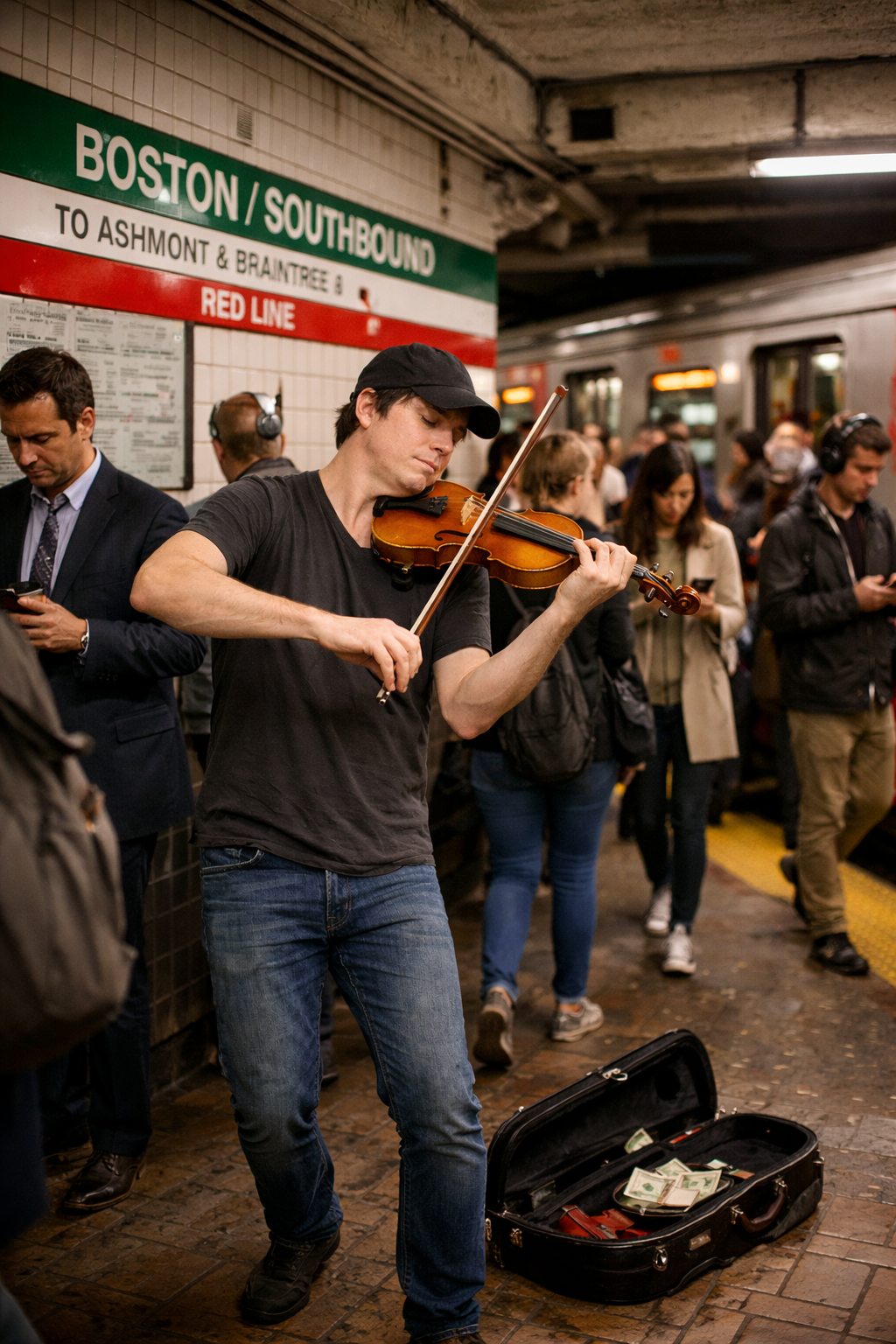
A world-class violinist. A three-million-dollar instrument. Rush hour at a Washington Metro station. And almost nobody stopped. The real lesson isn’t about being too busy. It’s about what a platform actually does to talent.
Experiment and Result
On January 12, 2007, world-renowned violinist Joshua Bell played incognito as a busker at L’Enfant Plaza Metro station in Washington D.C. — a social experiment on perception and beauty organised by The Washington Post. Dressed in jeans and a baseball cap, he played Bach’s composition Chaconne on his 1713 violin (valued at over $3.5 million) for roughly 43–45 minutes during morning rush hour.
Of the more than 1,000 people who walked past, only seven stopped to listen, no one applauded, and he collected just $32.17 in tips, $20 of which came from the single person who recognised him.
Context and Significance
Just two days prior to this, Bell had played same piece of composition with same violine at a theater in Boston, where seats averaged $100 and tickets for top seats were even higher.
What Happenend
Bell’s fingers didn’t forget how to play between Symphony Hall and that Metro corridor. The violin didn’t go out of tune. Bach didn’t become a worse composer overnight. Everything about the performance was identical. What changed was the world around it. The context. The architecture of the moment. That invisible signal telling a room full of people that this is worth stopping for.
That signal wasn’t there. So nobody stopped.
What a Platform Actually Does to People
Here’s what most people miss. A platform doesn’t just show your talent to the world. It tells the world how to feel about it before they’ve even seen it. A concert hall does its job before a single note is played. The lighting, the hush, the printed programme, the fact that someone paid good money to be there. All of it whispers to the audience: slow down. This matters. Open up.
Strip all of that away and even genius becomes wallpaper.
A doctor wearing his party suit and telling you to cut sugar at a dinner party lands very differently from the same doctor saying the exact same thing across a clinical desk with your test reports in front of you. The white coat and his clinic isn’t ego. It’s platform. It’s what makes the words land with weight. Without it, even the right advice sounds like opinion.
The Truth Nobody Wants to Say Out Loud
Alright. Here’s the part that’s going to sting a little. Look around your industry. Really look.There are people out there. You know some of them. Ordinary ability, extraordinary visibility. Average work. Great positioning. The right LinkedIn presence, the right conference slots, the right name in the right circles. And the world treats them like thought leaders. Meanwhile, people with decades of hard-earned, battle-tested skill are sitting quietly in the corner being useful and going largely unnoticed.
And the painful part? Deep down, they know it too. They feel it. That quiet frustration of being genuinely good at something and watching the recognition go elsewhere. That small voice at the end of a long day asking whether any of this even matters.
Platform-building is a skill. A real, serious skill. And it is completely separate from the talent it carries. If you refuse to build the stage, someone with half your ability will gladly stand on it.
That’s not cynicism. That’s just how visibility works. And the sooner you make peace with it, the sooner you stop waiting to be discovered and start deciding how your work reaches the world.
Stop Waiting. Build the Damn Stage
Nobody is coming to discover you. I wish that wasn’t true. But it is. There’s no talent scout wandering around your office or your project site looking for unrecognized brilliance to rescue. The world is too busy, too loud, and too full of people actively promoting themselves to go hunting for people who aren’t.
And I know what you’re thinking. It feels uncomfortable. It feels like showing off. It feels like something that people with big egos do, not people with real substance. I understand that. But here’s the thing: staying invisible isn’t modesty. It’s a quiet form of giving up.
Building your platform isn’t about becoming someone you’re not. It’s about being deliberate. Choosing the right rooms. Writing. Speaking. Publishing. Showing up where your work can be seen by people who have the authority to value it.
Joshua Bell could play. For sure in a brilliant way. But someone else built Symphony Hall. Someone else designed the acoustics, printed the programmes, set the ticket price, created the context that told Boston to show up and listen.
Most of us don’t have that someone else. So we have to be Bell and build the hall. Both. At the same time. Yes, it’s more work. Do it anyway. Your talent has waited long enough.
Always ask yourself before putting forth any idea, writeup, presentation, experiment or thought.
Are you playing at metro station ?
If this made you think, share it with one person who is talented and underestimated.
They’ll know exactly what it means.


Leave a Reply